
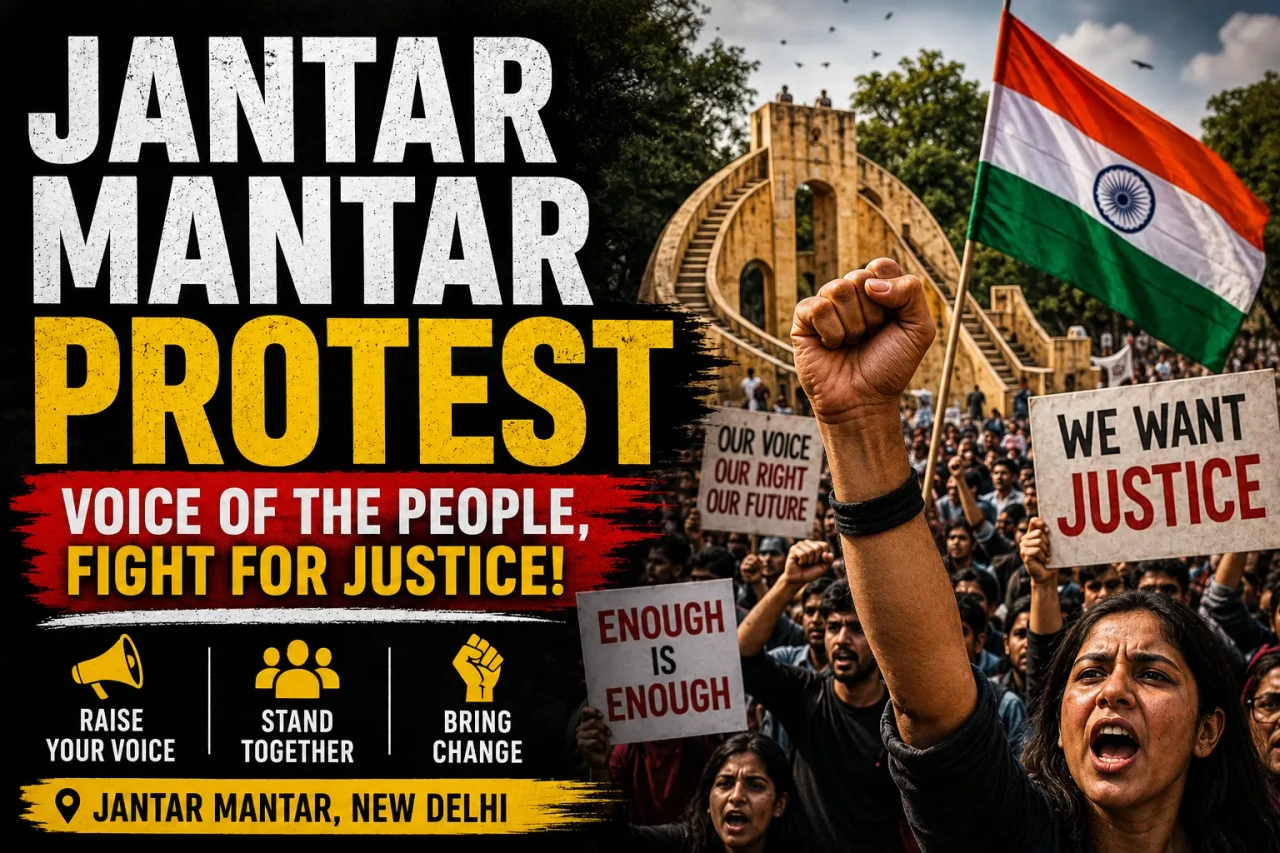
The NEET Protest at Jantar Mantar
For weeks now, Jantar Mantar has been the address of India's anger over its exams. Students, parents and activists have camped on the pavement demanding accountability for the NEET-UG 2026 paper leak — a scandal that surfaced after more than a dozen aspirants reportedly died by suicide, and after activist Sonam Wangchuk began a hunger strike on June 28 that he continued for over three weeks before being forcibly removed on July 18. The Cockroach Janata Party (CJP), led by Abhijeet Dipke, has turned the sit-in into a national headline. But as the cameras crowd in and the slogans get louder, it is worth pausing to ask an uncomfortable question: are we actually demanding a solution, or just a scapegoat? This blog looks at why the protest happened, how the narrative drifted away from NEET itself, and what we should really be asking the government.
Why This Protest Happened:
The trigger is real and serious. NEET-UG is the single gateway to every medical seat in the country — around 24 lakh students sit for it each year, many after two or three years of coaching, savings and sacrifice. When a paper leaks, it does not just advantage a few cheaters; it poisons the result for everyone honest. Protesters point to a chilling statistic repeated at Jantar Mantar: over 150 paper leaks across various exams in the last decade, affecting crores of aspirants. Add the reported student suicides and the government's slow response, and the outrage is not manufactured — it is the accumulated grief and exhaustion of a generation that feels the system is rigged against effort.
The Human Cost Behind the Slogans:
It is easy to reduce this to politics, but at its core the protest is about ordinary lives. A leaked paper means a cancelled or contested exam. A cancelled exam means another lost year for a 19-year-old — another year of coaching fees, another year of parents' hope deferred, another year of watching peers move ahead. For students on their final attempt, it can mean the end of a dream they have chased since childhood. The families who came to Jantar Mantar demanding a one-crore compensation for those who died were not asking for money; they were asking for someone, anyone, to admit that the system failed their children.
How the Narrative Drifted Beyond NEET:
Here is where things get complicated. What began as a demand to fix NEET has increasingly become a demand for one man's resignation. "Dharmendra Pradhan istifa do" and "We asked for Make in India, you gave us Leak in India" are catchy, shareable and emotionally satisfying — but notice what has happened to the conversation. Opposition leaders arrived, TV panels lit up, and the story became a familiar government-versus-opposition wrestling match. The paper leak became a stick to beat a minister with, rather than a systemic failure to diagnose and repair. When a protest's headline becomes a name instead of a reform, the powerful get a convenient exit: sacrifice the individual, save the system.
The Resignation Trap:
So let us ask the question directly: if Dharmendra Pradhan resigns tomorrow, does the next NEET leak-proof itself? No. A resignation is an act of symbolism, not structure. It satisfies the appetite for a villain, delivers a news cycle victory, and then everyone goes home — until the next leak, the next minister, the next protest. India has seen this loop before with exam after exam. Ministers are political appointees who come and go; the National Testing Agency (NTA), the exam architecture, the question-paper supply chain, and the coaching-mafia economy all remain exactly where they were. Demanding a scalp feels like accountability, but it can quietly let the actual machinery of failure off the hook.
The Questions We Are Not Asking:
If the goal is that no student ever loses a year to a leak again, the questions for the government have to change. Instead of only "Who will resign?", we should be asking: Why is the entire medical future of the country dependent on a single high-stakes paper that becomes a single point of failure? Why has the NTA — an agency running exams for crores — never been subjected to a binding, published security audit? Where exactly in the chain (printing, transport, storage, exam-centre custody) do papers leak, and why has that chain not been redesigned with encryption, staggered digital delivery, or on-demand computer-based testing? What happened to the recommendations of the earlier expert committees set up after previous leaks — were they implemented, and if not, who is answerable for that?
What Real Accountability Looks Like:
Accountability is not a resignation letter; it is a system that cannot fail the same way twice. That means a time-bound, independent judicial inquiry whose findings are made public, not buried. It means structural reform — or restructuring — of the NTA, with professional exam-security expertise and legal liability for lapses. It means fixing personal accountability for the specific officials in the specific failure, not just the person at the top of the org chart. It means the anti-paper-leak law actually being enforced with visible convictions. And it means published, measurable standards so that citizens can check, exam after exam, whether the system is getting safer or not.
Why This Distinction Matters:
None of this is to dismiss the protesters — their anger is legitimate and their presence at Jantar Mantar has forced a national conversation that would otherwise have been buried. The forcible removal of a peaceful hunger striker in the early hours of the morning, in particular, deserves scrutiny in any democracy. But a movement is only as strong as the change it leaves behind. If the protest ends with a resignation and a celebratory news cycle, the students who died will have been mourned but not honoured. If it ends with a rebuilt, audited, leak-resistant examination system, then Jantar Mantar will have done what it does best — turned grief into structural change.
Conclusion:
The NEET protest at Jantar Mantar is a test not just of the government, but of us — of whether we can hold our attention on the boring, technical, unglamorous work of fixing a system rather than settling for the drama of a downfall. Ministers can be replaced in an afternoon; a trustworthy examination system takes years of deliberate reform. The most powerful thing the protesters, the opposition and ordinary citizens can do now is refuse the easy win. Keep asking the harder questions. Because the real demand should never have been "who resigns" — it should always have been "how do we make sure no honest student ever pays for someone else's fraud again."